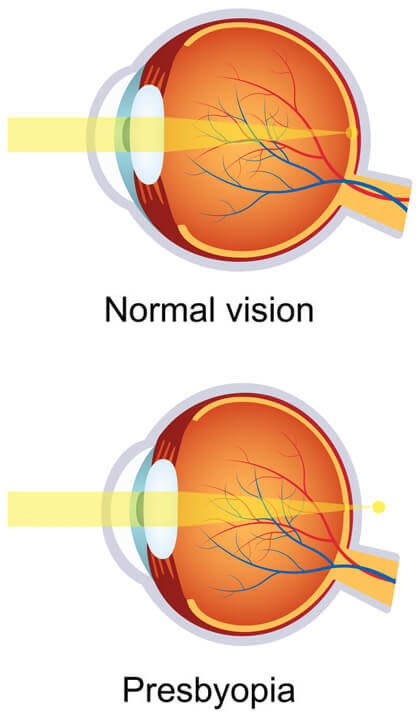
With presbyopia, you may experience symptoms such as:

Difficulty with reading, phone, or computer vision

Blurred vision at normal reading distance.

A need to hold reading material farther away to make the words clearer.

Eyestrain or headaches after reading or doing close-up work.

Increased dependence on reading glasses.
Presbyopia. Simplified.

A Normal Part of Aging
Most people develop presbyopia – difficulty reading without glasses – by our 40s.

You Have Options
Our customized vision correction options allow you to determine the range of vision you want after Lens Replacement surgery.

A Trusted Surgery
Much like cataract surgery, Lens Replacement is one of the most successful procedures.
Vision. Refreshed.
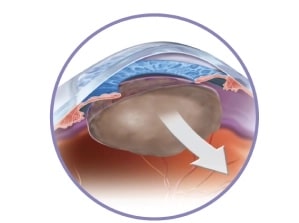
1 Lens Removal
Through a microscopic laser-created opening, Dr. Shatz removes your poorly functioning lens.
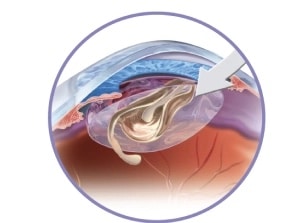
2 Lens Insertion
Dr. Shatz replaces your old lens with a new, artificial lens – that is customized to your particular vision needs.
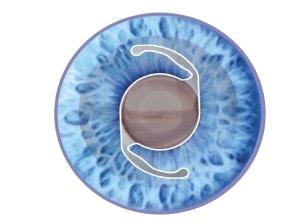
3 Vision Renewed
Your new lens will provide you refreshed vision at near, intermediate, and distance without worrying about getting cataracts in the future.
About Refractive Lens Exchange Surgery
Presbyopia is the condition that forces us to need reading glasses as we age. It occurs when the natural lens loses its flexibility as it grows throughout our lives.
The natural lens changes shape as we look at close objects, providing near vision. It is flexible in youth, much like a balloon that is only filled with a small amount of air. This flexibility decreases with age as the lens fills with more material, similarly to the balloon hardening as it is inflated. Our ability to focus at near starts to diminish in our mid-forties as the lens slowly hardens – a term called presbyopia.
Individuals who suffer from nearsightedness, farsightedness, and/or presbyopia – even if they do not have cataracts – can take advantage of a procedure that is identical to cataract surgery. Lens Replacement is ideal for patients in their late 40s and beyond, or for anyone who needs to wear reading glasses. The natural lens is replaced with an intraocular lens implant (IOL) that can permanently restore your vision. This outpatient procedure takes about 10 minutes to perform per eye, requires only eye drops as an anesthetic, and has a quick recovery time.
Depending on the type of IOL you choose, Lens Replacement surgery can provide freedom from glasses at all ranges! Whether you choose multifocal implants to improve distance, intermediate, and near, monovision to allow one eye to see far and one to see close, or single vision for distance or near, the IOL is selected to correct your individual needs.
Once the IOL is in place, the focus it provides does not degrade over time. Additionally, unlike the natural lens, the IOL will not cloud up over your lifetime, so once you have a Lens Replacement procedure, you will never develop cataracts or need to repeat this surgery!
At SightTrust Eye Institute, we offer our patients the option of treating both eyes on the same day, rather than one at a time. This provides a shorter healing time and quicker visual recovery, allowing you to see the best you can the soonest possible!
How Much Does RLE or Refractive Lens Exchange Cost?
Refractive Lens Exchange (RLE) is a procedure similar to cataract surgery but is performed to correct refractive errors without the presence of cataracts. The average cost of RLE is about $5,500 per eye. The price can depend on the type of lens selected. This cost includes pre-operative evaluations, the surgery itself, and post-operative follow-ups during the post-operative period. During your consultation our surgical coordinator will provide a complete detailed breakdown of costs.
How Long Does RLE Last?
The effects of Refractive Lens Exchange (RLE) are permanent. Once the intraocular lens (IOL) is in place, its focus doesn’t degrade over time, and unlike your natural lens, it won’t cloud over during your lifetime—so after a lens replacement procedure, you won’t develop cataracts or need to repeat the surgery. This means that RLE can permanently restore your vision.
Differences Between RLE & LASIK?
Both procedures reduce or eliminate your dependence on glasses, but they work on entirely different parts of the eye.
LASIK reshapes the cornea, the clear front surface of the eye, using a laser to correct how light enters. It leaves your natural lens in place. Refractive Lens Exchange takes the opposite approach: it removes the natural lens and replaces it with an IOL selected for your specific vision goals.
Because LASIK doesn’t touch the lens, it can’t stop presbyopia from progressing, and it doesn’t prevent cataracts from developing. RLE addresses both: the artificial lens never hardens and never clouds, so cataracts are off the table permanently.
Age and prescription usually determine which procedure fits. LASIK tends to suit younger patients with a stable prescription and sufficient corneal thickness. RLE is generally the better option for patients in their late 40s and beyond, and for those with higher degrees of farsightedness, nearsightedness, or corneas that rule out laser correction.
During your consultation, Dr. Shatz’s team of highly trained doctors will evaluate your corneal measurements, lens condition, and visual goals to recommend the procedure that fits you best.
What is the best age for refractive lens exchange?
Lens replacement is ideal for patients in their late 40s and beyond, or for anyone who needs reading glasses as well as distance vision correction. Since most people develop presbyopia by their 40s, and the ability to focus up close starts to diminish in the mid-forties as the lens slowly hardens, once you have had to wear readers or bifocals for at least 6 months, you may be an ideal candidate.
Who is not a candidate for refractive lens exchange?
RLE is a well-established procedure, but it isn’t the right choice for everyone.
Younger patients are typically not candidates. If your natural lens still focuses well at near, laser vision correction is usually the more appropriate option.
Certain eye conditions may also rule out RLE or require treatment first, including:
- Advanced or uncontrolled glaucoma
- Macular degeneration or other retinal disease
- Diabetic retinopathy
- Corneal disease, such as Fuchs’ dystrophy
- Active eye infection or inflammation
- Significant untreated dry eye
Patients with very high nearsightedness may carry an elevated risk of retinal complications and need a thorough retinal evaluation before moving forward. Uncontrolled systemic conditions, such as poorly managed diabetes, may also need to be addressed first.
Finally, expectations matter. RLE delivers excellent results for the right patient, but no procedure guarantees perfect vision in every situation and lighting condition.
The only way to know whether you’re a candidate is a comprehensive evaluation. Schedule a consultation at SightTrust Eye Institute, and we’ll walk you through your options.